Defining U.S. Foreign Policy is not a simple matter, yet one can follow a thread that goes back two centuries. On December 2, 2025, the White House published an official statement in which President-elect Donald Trump reminded the world of the Monroe Doctrine. With 202 years of validity, the president dedicated some words to this renowned American doctrine that gave rise to the much-questioned foreign policy that governs the country today.
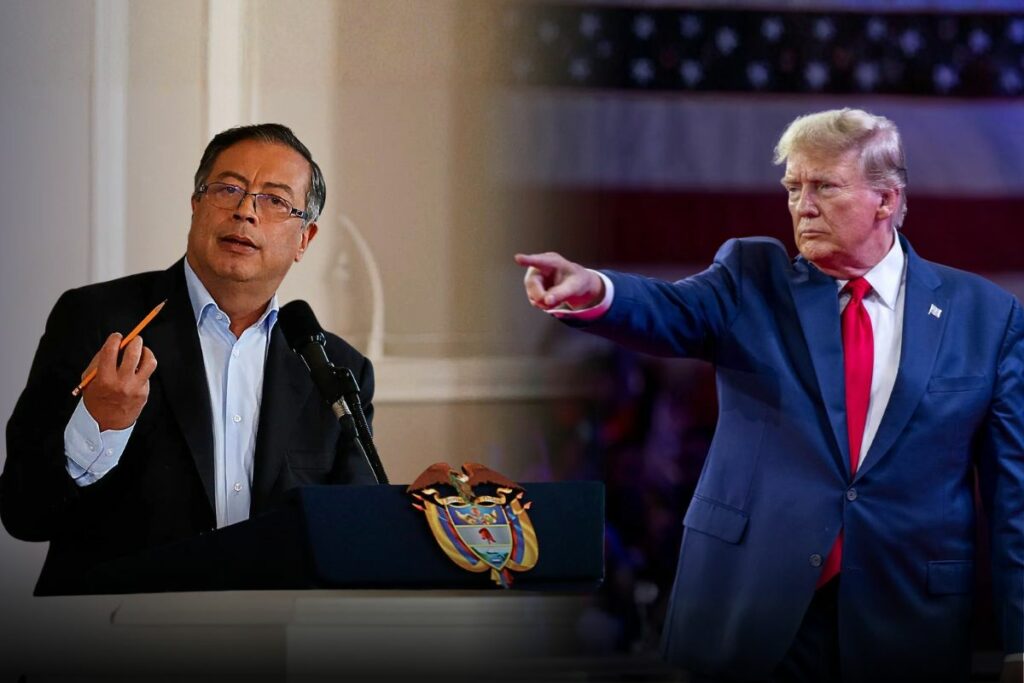
Starting abruptly with the imposition of tariffs on countries mainly in Latin America, he managed to generate terror in these domestic economies, also causing uncertainty in their markets and in the future of international free trade. In the case of Colombia, after President Gustavo Petro's statement regarding the deportation under inhumane conditions of a group of Colombian citizens living in the United States, where he refused to receive the plane in which they came handcuffed like criminals, President Trump decided on his own to impose a 25% tariff on all products imported from Colombia. He also pointed out that he could raise them to 50% if Petro did not change his stance and accept the deportation terms. With a dominant and forceful tone, Donald Trump began his strategy that would later escalate to unexpected levels.
Simultaneously, from the federal agency of the Department of Homeland Security (DHS) headed by Kristi Noem and under direct orders from Donald Trump, raids, detentions, and operations by ICE (Immigration and Customs Enforcement) would begin against thousands of immigrants, families, children, and women who, according to the U.S. government, represent a threat to the national security of the North American country. The main rationale was to label them as illegal immigrants or "Aliens," however, to this day there are multiple known cases of legal and naturalized American citizens with ancestry from other parts of the Americas who have been detained by ICE. It is true that in previous administrations, such as Barack Obama's, thousands of deportations were also recorded, however the criticism of the current government has been to point to the brutality, violence, and coldness with which government agents and officials operate and handle the immigration situation.
The Monroe Doctrine was first presented before the United States Congress on December 2, 1823, and was articulated by the fifth president, James Monroe, during his seventh annual State of the Union address.
The historical context of the time pointed to the recent independence of some countries on the American continent. Among these were Mexico, Gran Colombia (Colombia, Venezuela, Ecuador, and Panama), Brazil, Peru, Chile, Paraguay, Haiti, and of course the United States, as well as others that were close to achieving it. At the same time in Europe, the victorious powers emerged from the Congress of Vienna (1814-1815), and as a result of the end of the revolutionary Napoleonic wars, the Holy Alliance emerged between Russia, Prussia, and Austria to defend monarchism. All these events meant at that time a fear for the United States of the return of European colonial powers to the Western Hemisphere.
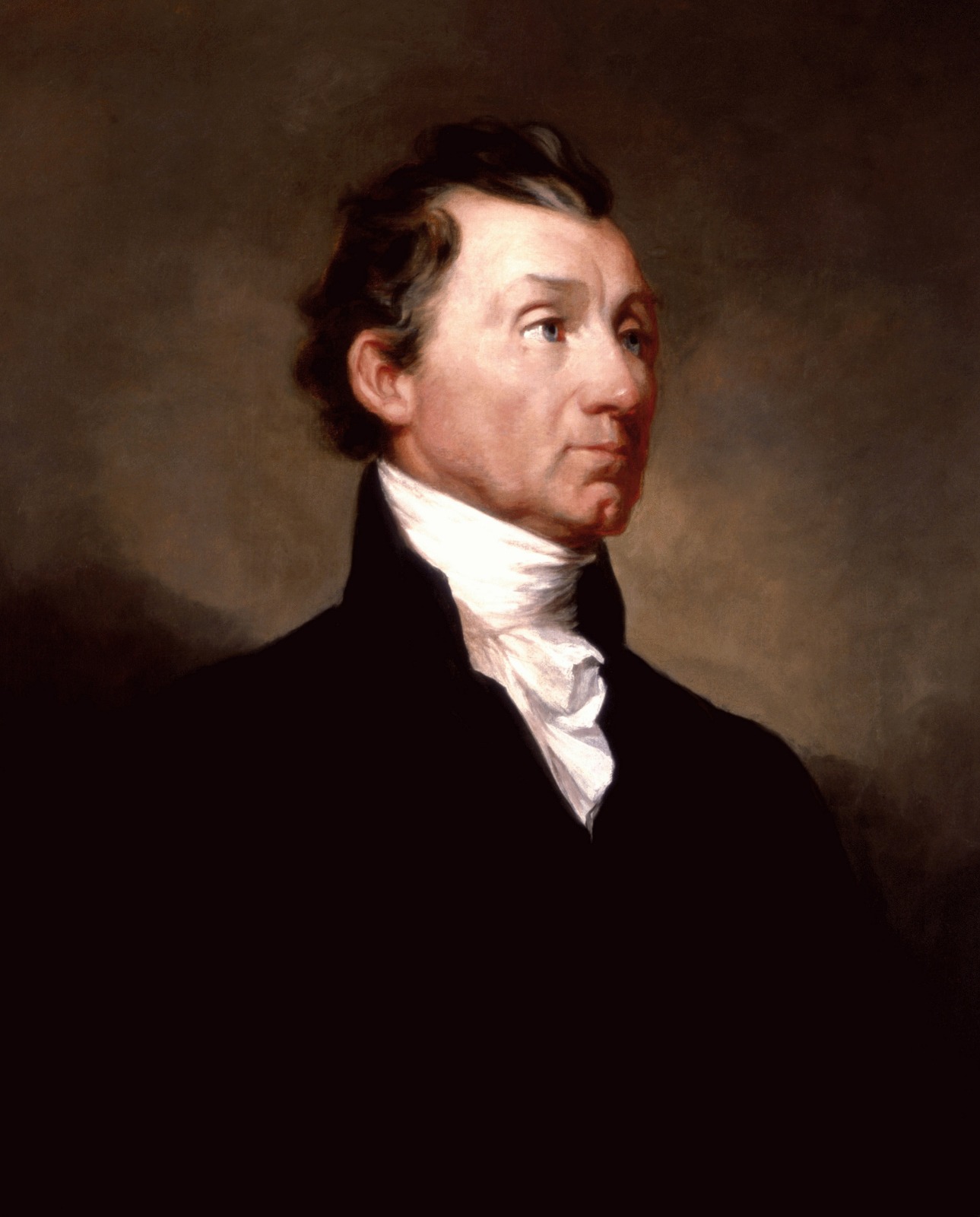
This need of the USA to prevent the continent on the other side of the Atlantic Ocean from once again dominating its territories led them to articulate the Monroe Doctrine. The author of the doctrine was John Quincy Adams, Secretary of State and sixth president of the United States, and finally accepted and pronounced by James Monroe.
The main objective of this doctrine was to warn all European powers, with special emphasis on the Holy Alliance and Great Britain, that the United States took a firm stance against European colonialism on the American continent. More explicitly, they referred to the fact that any intervention in any of the countries that had fought for their independence would mean a potentially hostile act against the United States. These words reaffirmed the sovereignty, independence, and total autonomy of American territories against Europe.
It would only be in the 20th century that the Monroe Doctrine would become the pillar of security and expansionist policy of the future power.
"America for the Americans"
"America for the Americans" is a famous phrase that surely everyone has heard. It was born alongside this context with a definition that would mutate over time. If initially this proclamation suggested the defense of all independent American nations by the USA, later it would turn into what it had intended to be from the beginning: The defense of the United States' own interests.
With U.S. support or omission, after adopting the Monroe Doctrine, the feared European interventions in American countries occurred. Some can be named such as the occupation of the Falkland Islands by Great Britain (1833), the blockade of French ships in Argentine ports (1839-1840), the Anglo-French blockade of the Río de la Plata (1845-1850), the Spanish invasion of the Dominican Republic (1861-1865), the French intervention in Mexico (1862-1867), the Spanish-South American War (1865-1866), the English occupation of Mosquitia (Caribbean Region), and the occupation of Guayana Esequiba (Venezuela) by Great Britain (1855).

The Roosevelt Corollary and the Big Stick Policy
It is worth asking then about the true intention of the doctrine, considering that it was unilaterally benefiting the United States and affecting the rest of the continent despite the fact that on paper it established the defense of all. By 1904, President Theodore Roosevelt issued the well-known "Roosevelt Corollary," following the naval blockade of Venezuela by European powers at the beginning of the 20th century, establishing that "if a European country threatened or endangered the rights or property of American citizens or companies, the U.S. government was obligated to intervene in that country's affairs to 'reorder' it, restoring the rights and property of its citizens and companies."
In this way, the dynamics of the country's foreign policy and national security were woven and expanded with greater intensity, clarifying that what was truly being formed was an imperialist and colonial nation. This corollary would truly represent free passage for the United States to justify numerous interventions in Latin America and the Caribbean.
From this point on, U.S. foreign policy would cease to operate solely from a discursive or doctrinal level to become a systematic practice of power, known as the Big Stick Policy. More than a formal doctrine, the Big Stick represented a logic of action: the explicit or latent use of force as a mechanism to ensure the primacy of American interests in the Western Hemisphere. Diplomacy came to be permanently backed by military, economic, or political threats, configuring a deeply asymmetric relationship between the United States and the rest of the continent.
Under this logic, the United States repeatedly intervened in the internal affairs of Latin American countries, not only through military occupations but also through control of customs, the imposition of unequal agreements, support for friendly governments, and direct protection of American companies and capital. Regional stability was no longer defined in terms of self-determination of peoples and came to be interpreted from the parameters of security, order, and profitability established by Washington. In this scheme, any attempt at political or economic autonomy could be considered a threat that justified intervention.
This view not only legitimized external interference but also consolidated a hierarchical vision of the continent, in which the United States attributed to itself the right to decide when and how order should be restored. In this way, U.S. foreign policy adopted an openly imperial character, although wrapped in a discourse of protection, stability, and international responsibility.
This dynamic would profoundly mark the political history of Latin America during the 20th century and set a lasting precedent: the normalization of the use of coercion as a legitimate tool of foreign policy. The Big Stick was not an isolated episode, but the crystallization of a way of understanding power and hemispheric security that, with adaptations and new instruments, continues to project itself to the present day.
The Monroe Doctrine in the 21st Century
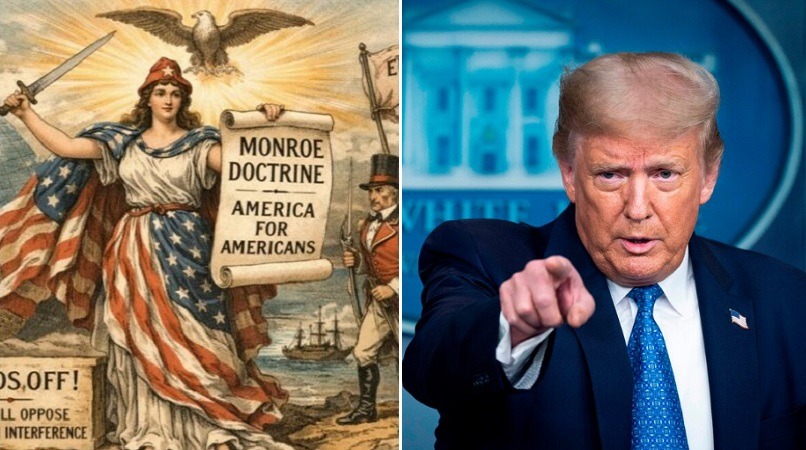
Thus, it can be affirmed that the Monroe Doctrine not only remains in force, but was explicitly reaffirmed in December 2025 by President Donald Trump, who maintained that the principles enunciated by James Monroe still constituted the basis of American action in matters of security and foreign policy. However, this reaffirmation was accompanied by a markedly more aggressive and belligerent tone, to the point that the president himself introduced what he called his "Trump Corollary."
"Reinforced by my Trump Corollary, the Monroe Doctrine remains in force, and American leadership returns stronger than ever. Today we renew our commitment to always defend the sovereignty, security, and protection of the United States as a priority."
These statements did not remain confined to the discursive level, but laid the political and symbolic foundations for the events that occurred at the beginning of 2026, when the United States militarily intervened in Venezuela and Nicolás Maduro was arrested and transferred to DEA facilities in New York. Beyond the arguments used to justify this action, the episode highlighted the persistence of a logic of unilateral intervention in the hemisphere.
Reactions in Latin America and other regions of the world were deeply divisive. However, beyond determining who is right or who is wrong, it is urgent to analyze the conviction with which the U.S. government communicates and executes these policies. In this sense, the statements of Defense Secretary Pete Hegseth —who echoed the famous phrase attributed to Henry Kissinger by stating that "Latin America is America's backyard"— reveal the continuity of a hierarchical vision of the continent.
Conclusion
After this historical journey, a central question arises about the future of the American nations that fought centuries ago for their independence. If independence implies the existence of sovereign, free, and autonomous States, it is essential to observe how, from now on, disagreements and disputes between the United States and those countries that do not align with its terms will be managed.
Because if all States are formally sovereign, why does one of them continue to act as the world's police?