One year after the start of what was then called the Great War, now known as World War I, what is considered the first genocide of the 20th century would materialize: the Genocide of the Armenian people at the hands of the Ottoman Empire. This crime would bring terrible and devastating consequences, both for the dignity of the Armenian people and for their memory. And, as if that were not enough, there is a part of this story that has been silenced with even greater force: the gender-based violence perpetrated against Armenian women.
Studying the history of a genocide is not a simple task, but beyond its historical complexity lies the heartbreaking and dehumanizing nature of its content. For that very reason, it must be essential to keep memory intact, not to continue living in a past time, but so that in future times such calamitous acts have no place in human history.
This work aims to make visible and raise awareness of how, in a context that is already inhumane for everyone, women end up being symbolic territory of conquest, through rape, sexual slavery, forced motherhood and conversions, which have left marks on their souls and bodies. Furthermore, it will analyze how denialism plays an important role in the re-victimization of these women, not only the direct victims but also their descendants, forcing them to reconstruct their history in an environment that denies or minimizes their suffering.
Chapter I: Background
Understanding the origins of the word "Genocide"
It seems incredible to think that a word used quite frequently today to describe and categorize events from distant pasts, such as the Genocide of indigenous peoples, was only coined in 1943. The genocides committed during the early and mid-20th century were of such magnitude that they led Polish lawyer Raphael Lemkin to seek a way not only to name these barbarities but to have them recognized legally.
His main motivation was due to what was happening during World War II, with Nazi extermination policies against Jews. Horrified by the events and the lack of an international policy to punish and hold the executors responsible, he decided to work on a term that could encompass the dimension and magnitude of the acts.
"Genocide" is formed from the Greek noun genos ('race', 'people') and the Latin suffix cide (from caedere, 'to kill'). It proposes the general definition: Elimination of all or part of the target group.
After the war ended, and arguing that the now-defined concept of Genocide had no legal weight in international law, Lemkin dedicated most of those years to creating an appropriate international convention to handle genocide cases. Thus, in 1948, the UN General Assembly approved the Convention on the Prevention and Punishment of the Crime of Genocide, ensuring this crime has legal weight in the international legal system.
"For Lemkin, genocide went beyond physical mass elimination, which in his view was a borderline and exceptional case; it consisted, rather, of a multiplicity of actions aimed at destroying the foundations of a group's survival as a group."
Hamidian Massacres: Planting the seed of hatred
From 301 AD, under the reign of King Tiridates III, Armenia officially declared itself Christian, becoming the first country in the world to adopt Christianity as a state religion. By 1555, the Western part of Armenia had been delegated to the Ottoman Empire by the Peace of Amasya. This part of the region would be called Ottoman Armenia. From this moment, the Armenian people would be implicitly subordinated to the jurisdiction and will of the Ottoman Empire.
The Armenian genocide is officially documented between 1915-1923; however, historians have carried out arduous work analyzing socio-cultural, political, geographical, and ideological contexts to show that this macabre plan had been weaving itself together long before those dates.
To understand it, one must start from the basis that the Ottoman Empire was mainly composed of an elite of Ottoman Muslims, and that the rest of the religious minorities, who were organized in a system called "Millet," lived in precarious conditions, excluded and considered by Ottoman Muslims as second-class citizens.
Between 1877-1878, the Russo-Turkish War took place, which brought great territorial losses to the Ottoman Empire, in addition to an accentuated paranoia about a possible collapse of the empire. All this worsened with the Treaty of San Stefano, which, by declaring Russian victory, only managed to create an atmosphere of resentment from the expelled peoples toward Christians.
To make matters worse, the then Sultan Abdul Hamid II accused the Armenians of having been accomplices of the Russians, planting a seed of hatred and suspicion toward minorities, and especially toward Armenians, who began to be perceived as a threat to Muslims and the Empire. After the Sasun revolt of 1894, where Armenians rebelled against abuses by the Ottoman army, the Sultan did not hesitate to take advantage of the chaos to justify the massacres he would soon perpetrate against minorities. Between 100,000 and 300,000 Armenians were massacred and murdered; these are called the "Hamidian Massacres."
The Young Turks and the execution of the plan
After these massacres, it was expected that Armenians would think about having their own State. Unfortunately, this would not be possible. In 1908, the Committee of Union and Progress (CUP), also known as the Young Turks, overthrew Sultan Abdul Hamid II through a coup d'état. This revolutionary nationalist and Ottoman reformist political party ended up further marginalizing the Armenian community. As if this were not enough, after losing the Battle of Sarıkamış against Russia, Armenians were again accused of treason. This was the perfect reason to execute the plan.
Like all Genocides, this one contained a strategy to foresee which part of the Armenian population should be exterminated first. Directive 8682 defined the first group. Under this directive, soldiers and other Muslims who were part of the army were demobilized and transferred to labor battalions. Already disarmed, they would be systematically murdered by Ottoman troops.
Secondly, in April 1915, Talat Pasha, a member of the Young Turks, ordered the arrest of 250 intellectuals, including some deputies of the Ottoman parliament, to finally assassinate them. The main objective was to prevent their voices from reaching the international system.
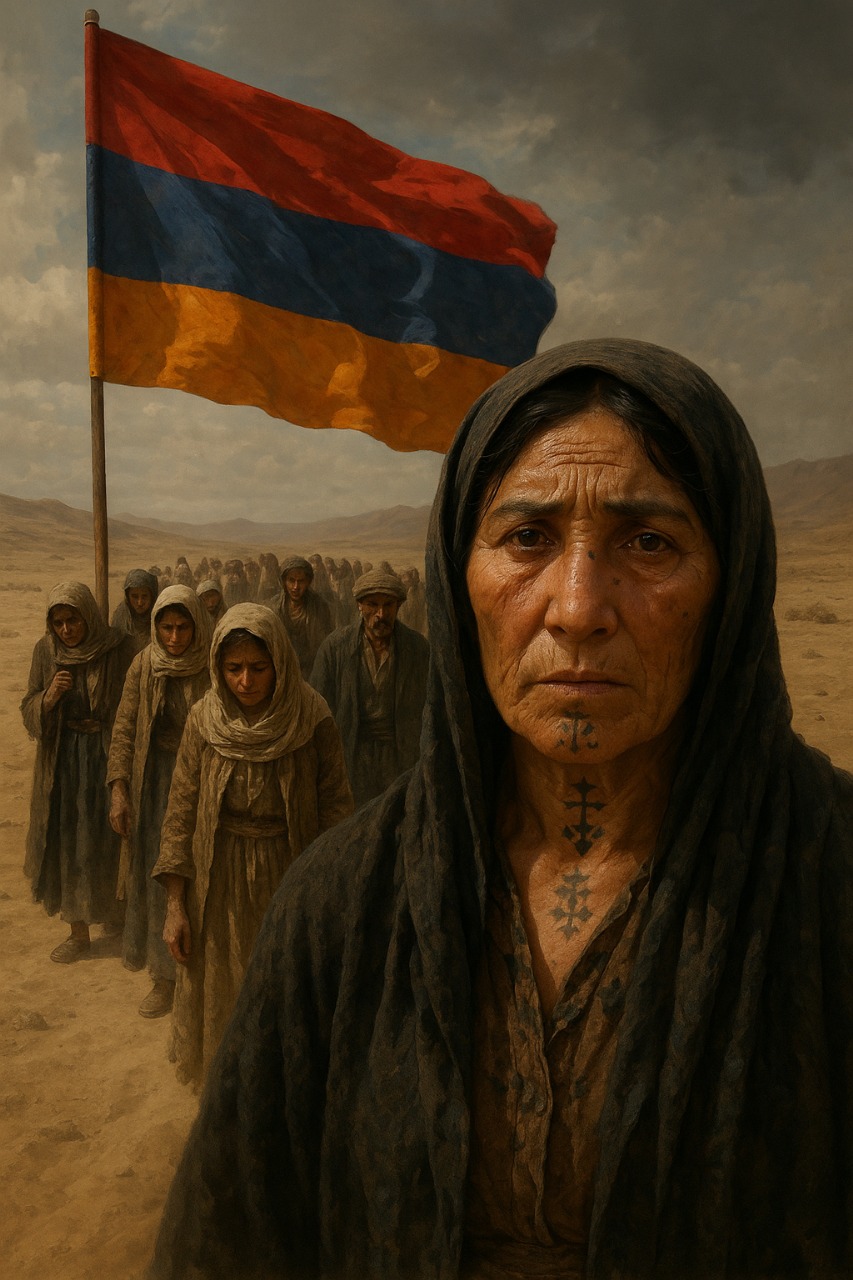
All this river of blood would flow into the sands of the Syrian Desert. On April 24, 1915, the CUP approved the Tehcir Law, which gave the Ottoman government the power to deport anyone it considered a threat to state security. The deportations were mostly of women, children, and the elderly, many of whom ended up becoming an eternal part of this sandy soil, whether through dehydration, malnutrition, or exhaustion, or directly by army bullets. It is estimated that 1.5 million Armenians were killed during the genocide.
Chapter II: Gender-based violence in the Armenian Genocide
Instrumentalization of gender-based violence
In the previous chapter, a brief scan of the genocide's background was made, showing that the events from 1915 onward were just the tip of a colossal iceberg of hatred and resentment. The extermination strategies analyzed above do not include one of the most overwhelming and devastating tools used during the genocide: Gender-based violence.
Nations, throughout history, are conceived as masculinized entities, where power is possessed and held by men, and women are reduced to the private sphere, where their contributions in the public sphere often end up being ignored or erased from history. For this reason, in a society created by and for men, it is important regarding crimes against humanity such as genocides to meticulously observe the role of women.
Under this framework, key pieces will be found to understand the use given to women, their bodies, and their spirits to achieve a goal. It is clear that referring to women as a genocidal strategy may seem disturbing, chilling, but as Lois A. West mentioned, "In colonial struggles, women are perceived as the booty of the male conquerors." In other words, the ideal means for oppressors to humiliate the rival group is through the violation and rape of women.
Surviving women and children had to function as a tool for the prolongation and maintenance of the Ottoman Empire and the prevalence of the Muslim population over Christians.
"Part of the annihilation plan of the Young Turks involved the transfer of young children and women to Muslim households and orphanages for incorporation and Islamization."
The body as territory of conquest
One of the major strategies involved the symbolic kidnapping of women and children into specific spaces that facilitated incorporation and conversion to Islam. Childhoods were violated and subjected to reconfiguring their thoughts, beliefs, and memories, as were young women and women, but adding an extra ingredient: the instrumentalization of their bodies.
Armenian women were subjected to sexual rape, slavery of the same nature, forced to go through forced motherhood and the traumatizing experience of raising a child knowing that the power of decision lies with the oppressor. All those traits that make us human, our spirit, our passion, love for life, for others, our desires, dreams and aspirations, our warmth—the Ottomans had stripped them from Armenian women. Now being conceived as objects, inert bodies.
It becomes clear then that these actions were not simply collateral effects of the genocide, but deliberate practices to dismantle Armenian identity.
"Women as the nation's uncontaminated unique core… mothers needed to be educated so that they could raise a new generation with a new national consciousness."
Denialism and invisibilization of gender-based violence
It is evident that in the long term this macabre and dehumanizing plan did not last nor achieve its goal (preventing the creation of an Armenian State); however, it can be affirmed that it brought consequences for the memory and identity of the Armenian people and particularly for women. Acts of such calamity leave internal marks. The traumas that arise at emotional and mental levels are evident; however, these were not the only scars that endured.
Through the documentary Grandma's Tattoos, Suzanne Khardalian, an Armenian woman, descendant of a victim of the Armenian genocide, shares what it was like for her to discover the meaning of her grandmother's tattoos. In this journey of discoveries, Suzanne unearths the most heartbreaking memories of her family.
During the genocide, young women and women who were victims of sexual rape were marked not only internally but tattooed on their bodies as a symbol and proof that they were finally conquered territories. Through these tattoos, Armenian women were transmitted that their individual rights and freedoms, their autonomy, their identity and memory were subordinated to the will of the conquerors.
Over the years, these young women had now become grandmothers, with children and grandchildren. They would have to live with their families' curiosity about their marked bodies. Suzanne's grandmother, and many Armenian grandmothers like her, left this world with a distorted memory and identity, because of the great weight that these dehumanizing acts brought to their bodies and minds.
Although Tatoosh's story to her granddaughter Suzanne about those peculiar tattoos went no further than phrases like "When I was young we liked to play at tattooing ourselves," the truth is that in her eyes one could contemplate a lifetime of denialism and invisibilization. Since 1915 they have been exposed to their perpetrators making a constant effort to minimize or directly deny the facts as we know them today.
To deny means to re-victimize, forcing victims and descendants to enter a struggle for visibility and reconstruction of their memory in the international arena. Recognition is part of reparation and is something that both the people in general and women in particular continue to seek today.
Conclusion
The objectives of a genocide are not limited solely to the physical and systematic elimination of a human group. The ambition of those who commit these crimes goes much further: what is sought is to eradicate the very soul of the people, to erase their history, their culture, their collective identity, and everything that allows them to recognize themselves as a community. Under this logic of total annihilation, it is not enough to kill men, women, and children. It becomes necessary to attack their deepest foundations, those that allow the transmission of memory, customs, language, and faith: women.
In the case of the Armenian genocide, it has been shown that the instrumentalization of gender-based violence constituted a strategic tool to achieve that total destruction. Women were not only physically and sexually assaulted but were also used as symbolic territories of conquest, as vehicles to erase Armenian heritage and impose, in its place, the cultural and religious codes of the Ottoman Empire.
Through systematic rape, forced motherhood, religious conversions, and tattoos marked on the skin, the aim was to destroy the continuity of the Armenian lineage, transform female bodies into spaces of domination and silencing, and eliminate any possibility of resistance through identity.
Suzanne Khardalian's discovery about the history of her grandmother, Tatoosh, not only allowed her to reconstruct her genealogy but also to confront the silence imposed on thousands of women who were dehumanized, marked, and forgotten. This individual search becomes a symbol of a collective struggle: the need to restore memory, to break with denialism, and to give voice to those who for too long have been silenced.
With pain, but also with hope, thousands of descendants today continue the work of reconstructing the truth and reclaiming their roots. They fight so that the genocide is not forgotten, so that gender-based violence is not normalized, and so that peoples who have been marked by horror can someday find a way to heal.
In memory of Armenian women.
Bibliography
- UNIVERSIDAD NACIONAL DE TRES DE FEBRERO (2014) INTERNATIONAL CONGRESS ON ARMENIAN GENOCIDE On the eve of the centenary
- Antaramián, C. (2016) Historical outline of the Armenian genocide. Rev. mex. cienc. polít. Soc.
- Educ.arportal (2023) Armenian women and genocide
- Bleyan, V and Antaramián, C. (2023) The antecedents of the Armenian genocide: Hamidian Massacres and Adana Massacre, Página12
- Ekmekçioğlu, L. Recovering Armenia: The limits of belonging in Post-Genocide Turkey. Stanford University Press.
- Grandma's Tattoos by Suzanne Khardalian
- Armenian National Committee of America. Armenian Feminism and Reconstructing the Post-Genocide National Identity.